Incode Ranks Among Top Performers in DHS S&T RIVR Track 2 Document Validation

Incode
February 24, 2026•
.png)
February 24, 2026•
The U.S. Department of Homeland Security (DHS) Science and Technology Directorate (S&T) recently released final results from Track 2 of the Remote Identity Validation Rally (RIVR), the Document Validation track of its large-scale evaluation designed to assess how well industry solutions verify identities remotely under real-world conditions.
In the published results, Incode is identified as DVS 5. Full results are available through the Maryland Test Facility at mdtf.org/rivr/Results.
This result builds on Incode's performance in Track 1, where Incode was one of five systems to meet DHS S&T performance goals in the Selfie Match to Document track. [Read more here.]
The Remote Identity Validation Rally is a rigorous, independent, multi-stage evaluation led by DHS Science and Technology to assess the accuracy, security, and robustness of remote identity verification technologies.
The program is structured across three tracks:
This article focuses on Track 2, the Document Validation track.
Track 2 evaluated how effectively commercial systems determine whether a state-issued driver's license or ID is genuine using images captured on common smartphones.
The evaluation included genuine and fraudulent documents across multiple issuing states, images captured under varied real-world conditions, and standardized performance thresholds established by DHS. Systems were measured across three core metrics:
Together, these metrics assess fraud detection performance, user friction, and system reliability.
RIVR Track 2 at a glance
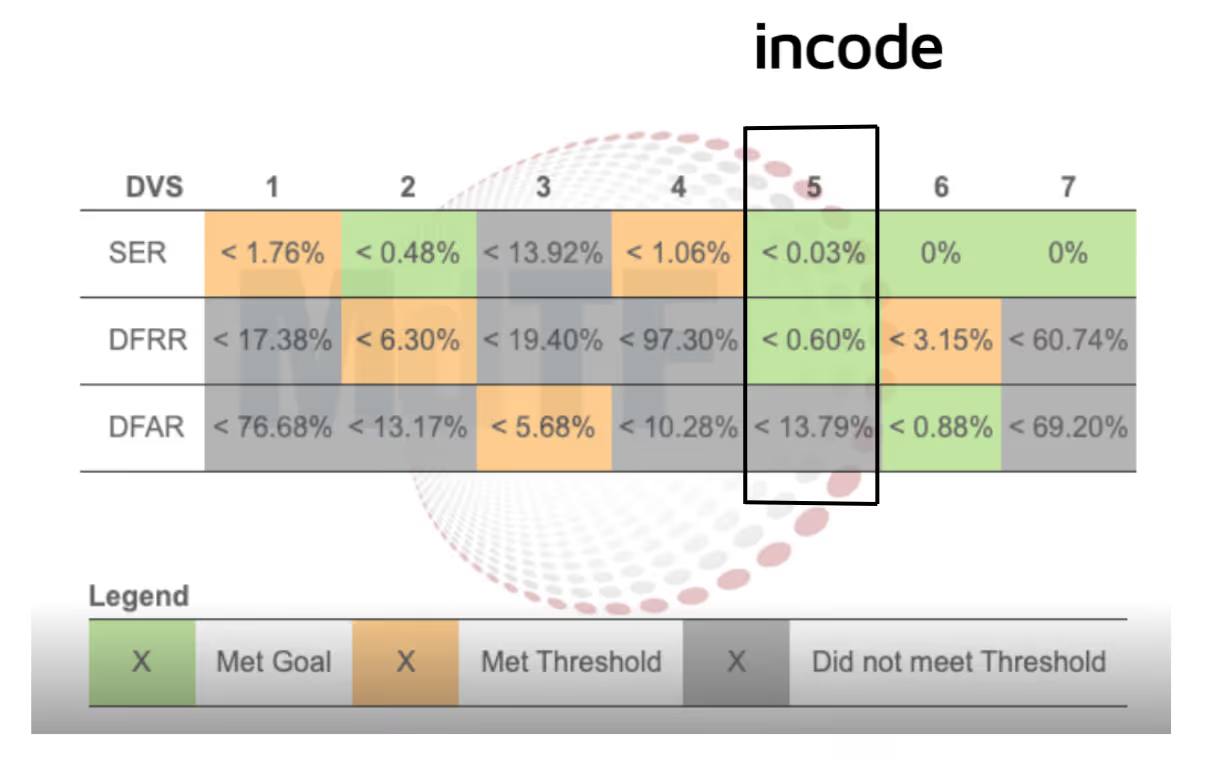
Document validation systems operate on a configurable threshold that trades off fraud detection against user friction. Incode's Rally submission was optimized for low friction, delivering the industry's best DFRR. The underlying model's discriminative capability extends well beyond that single operating point.
The more complete picture comes from the Detection Error Tradeoff (DET) analysis, which maps performance across all possible thresholds. DHS noted:
"DVS 5 [Incode] had comparable discriminative power - given an alternative threshold DVS 5 [Incode] could have met RIVR IDV performance benchmarks."
.avif)
The DET curves show that at more conservative thresholds, Incode's system is capable of meeting all three DHS benchmarks simultaneously. The submitted threshold simply reflects a deployment profile optimized for user experience. Organizations can tune Incode's system to match their specific risk tolerance and regulatory requirements without sacrificing underlying detection capability.
Remote identity systems must perform consistently across a wide range of devices and issuing authorities. Incode demonstrated stable error rates across smartphone models and document types, reflecting robustness under varied capture conditions, which is critical for both government and commercial deployments.
Document validation is one of the hardest problems in remote identity verification. Independent evaluations like RIVR provide much-needed clarity in a crowded market, helping organizations understand where a system sits on the fraud detection vs. user friction tradeoff and what its full capabilities look like across operating configurations.
Incode is well-suited for organizations that need that flexibility across use cases including:
Track 3 focuses on biometric spoof and presentation attack detection, addressing increasingly sophisticated identity threats. Incode continues to participate across all RIVR tracks as DHS advances its evaluation framework.
If you'd like to learn more about how Incode applies these capabilities across workforce identity, digital onboarding, and high-risk authentication flows, contact the Incode team.
Incode was named a Leader in the 2025 Gartner® Magic Quadrant™ for Identity Verification. Download the report.
%20(1).avif)