Incode Among Five Systems to Meet DHS S&T Goals in the Remote Identity Validation Rally

Incode
February 5, 2026•
.png)
February 5, 2026•
The U.S. Department of Homeland Security (DHS) recently released results from its Remote Identity Validation Rally (RIVR), a large-scale, government-led evaluation designed to assess how well industry solutions can verify identities remotely under real-world conditions.
Incode participated in the Selfie Match to Document track of the Remote Identity Validation Rally (RIVR). Based on the publicly released results, Incode’s submission met the performance goals established by DHS Science and Technology (S&T) across all evaluated metrics.
While DHS anonymized vendor names in the public report, Incode was one of five participating vendors whose submissions met these performance thresholds. System identifiers referenced in this post correspond to DHS-assigned system IDs used in the public RIVR report.
The Remote Identity Validation Rally (RIVR) is a rigorous, independent, multi-stage evaluation led by DHS Science and Technology (S&T) to assess the accuracy, security, and robustness of remote identity verification technologies.
The program is structured across three tracks:
This article focuses on Track 1, the Selfie Match to Document track, where vendors were evaluated on their ability to accurately match a live selfie to the portrait image on a government-issued ID under real-world conditions.
The evaluation used:
Systems were measured across four core metrics, including Failure to Extract Rate (FTXR), False Match Rate (FMR), and False Non-Match Rate (FNMR), with special attention paid to difficult, real-world impostor scenarios.
16 vendors evaluated in the Selfie Match to Document trackIncode’s system was among only five evaluated systems that met all DHS Science and Technology (S&T) performance goals
Incode’s submission was evaluated among 16 participating vendors in the Selfie Match to Document track. In the final results, only five systems met the more stringent DHS RIVR goals across all metrics. While DHS does not publicly map vendor names to system IDs, Incode’s submission (MTDS10) was among the systems that met all DHS Science and Technology (S&T) performance goals.
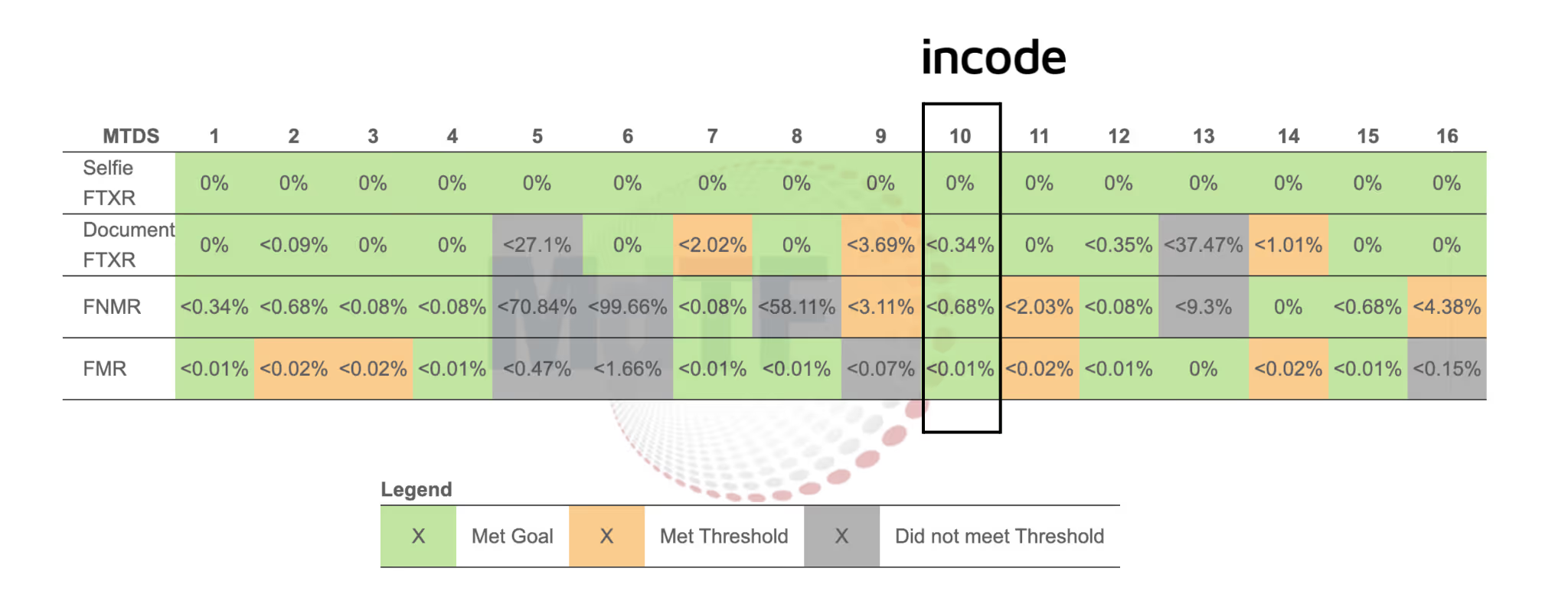
DHS analysis characterized the top-performing systems as operating with low error rates under worst-case conditions. Within this group, Incode’s system (MTDS10) was identified as a balanced performer, delivering:
In particular, DHS analysis showed that MTDS10 demonstrated a stable and well-balanced FNMR, positioned between more permissive systems that minimize friction and more conservative systems that prioritize strict matching thresholds. This balance is critical for organizations operating at scale.
RIVR results underscore an important reality: preventing identity fraud isn’t just about driving error rates to zero, it’s about choosing the right operating point.
As DHS noted in its findings, top-performing systems must:
Incode’s performance reflects that balance, as highlighted in the DHS analysis. Incode’s system achieved strong results in random impostor testing and same-source (demographically similar) impostor scenarios, without introducing excessive friction for real users.
This makes Incode particularly well-suited for large-scale, real-world identity verification use cases, including:
The DHS RIVR comes at a time when identity threats are growing more sophisticated, from deepfakes and synthetic identities to targeted impersonation attacks. Independent evaluations like RIVR provide much-needed clarity in a crowded market.
Industry coverage of the results reinforced this divide, noting that only a small subset of participants were able to meet DHS S&T goals under challenging impostor conditions.
Incode’s inclusion in this top tier reflects years of investment in biometric accuracy, anti-spoofing, and real-world deployment at scale.
This evaluation represents Track 1 of 3 in the broader RIVR program. Track 2 focuses on document authenticity, and Track 3 addresses biometric spoof and presentation attack detection. Incode continues to participate across these tracks as DHS advances its work to strengthen remote identity validation.
If you’d like to learn more about how Incode applies these capabilities across workforce identity, digital onboarding, and high-risk authentication flows, contact the Incode team.
Incode was named a Leader in the 2025 Gartner® Magic Quadrant™ for Identity Verification. Download the report.
%20(1).avif)