The Workforce Identity Crisis of 2025. What It Exposed About Modern Attacks

Harsha Balakrishnan
January 22, 2026•
January 22, 2026•
As organizations closed the books on 2025, one theme stood out across breach reports, investigations, and government advisories. Identity had become the most exploited weakness in the workforce.
Throughout the year, attackers bypassed technical controls not by breaking systems, but by convincingly impersonating people. They posed as job candidates, employees, executives, and IT support callers. In doing so, they exposed a widening gap between how organizations assume identity works and how adversaries exploit it in practice.
By the end of 2025, it was clear that workforce identity risk was no longer limited to hiring fraud or isolated insider threats. It now spanned the entire employee lifecycle, from recruiting to help desk interactions, and was increasingly driven by organized, well-resourced groups.
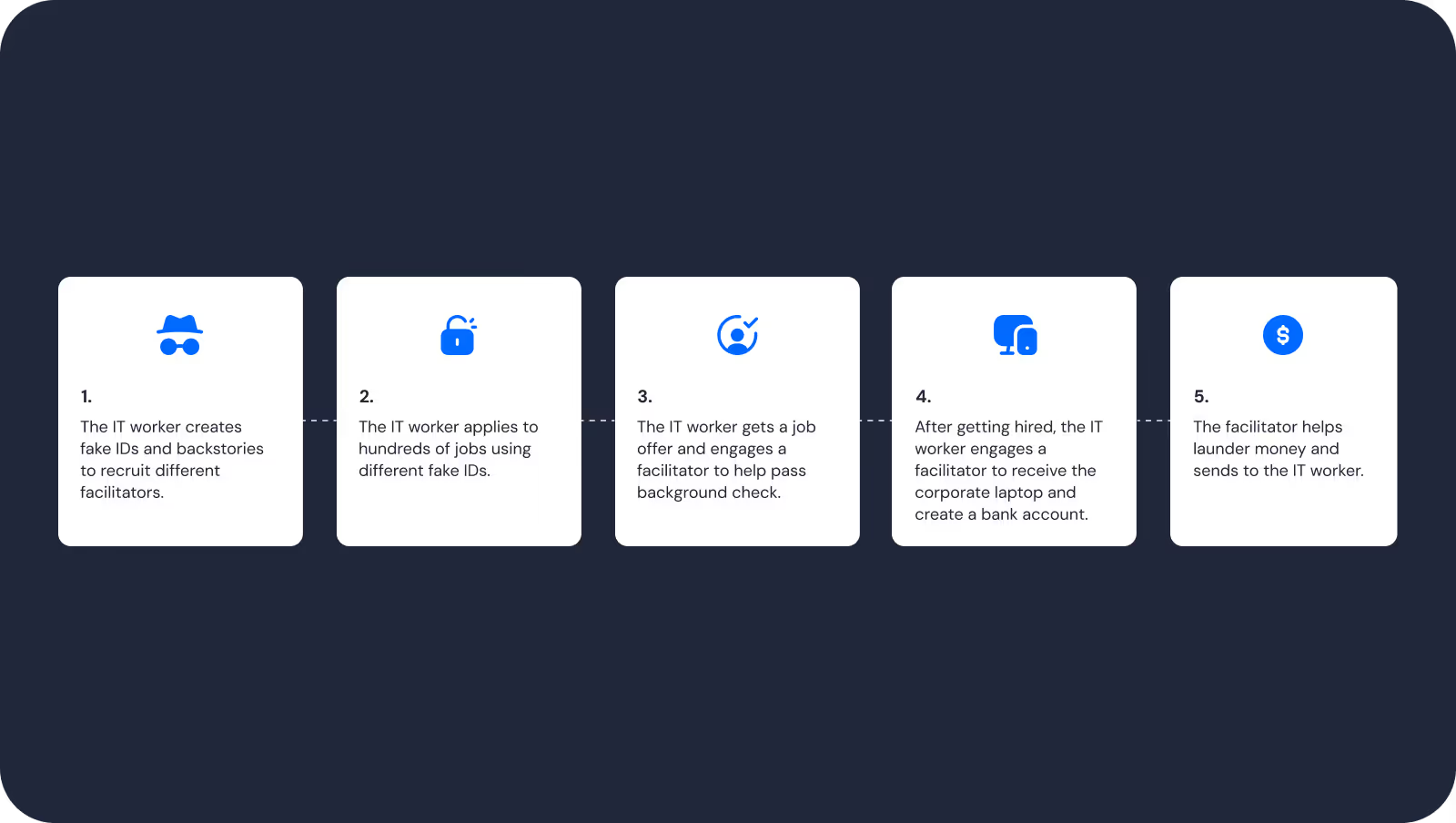
One of the most visible stories of 2025 involved North Korean remote IT workers infiltrating Western companies by posing as legitimate employees. Government advisories and indictments detailed how operatives used stolen and synthetic identities, proxy interviews, VPN obfuscation, and U.S.-based intermediaries to pass digital hiring processes.
Investigators cited more than 6,000 attempted placements. In many cases, corporate laptops were shipped to domestic facilitators while the actual workers operated overseas. These were not isolated scams. They were coordinated operations that treated hiring pipelines as a repeatable attack vector.
As the year progressed, it became clear this was not an anomaly. It was a preview.
While hiring fraud drew early attention, other attackers focused on a different weakness: access support.
Groups like Scattered Spider demonstrated how effective social engineering could be when identity verification is inconsistent. In 2025, the group was linked to attacks across retail, financial services, and airlines. In several incidents, attackers gained initial access by impersonating employees or executives and targeting help desk and IAM workflows.
In some cases, IT teams were convinced to reset passwords or MFA through self-service identity and access management tools. From there, attackers moved laterally through VPNs, remote access environments, and virtual infrastructure, eventually accessing sensitive systems and credentials.
These attacks succeeded not because of sophisticated malware, but because processes assumed that the person making the request was legitimate.
By the end of the year, social engineering was no longer a supporting tactic. It was the primary entry point.

Across hiring, onboarding, and IT support, organizations continued to rely heavily on human intuition. Recruiters assessed resumes and interviews. Help desk staff made judgment calls under pressure. Identity checks, when they existed, were often manual or easy to bypass.
In 2025, generative AI made this approach increasingly fragile. Attackers used polished synthetic resumes, AI-assisted interviews, deepfake videos, and proxy actors to defeat traditional screening. In some cases, the person on camera was not the person being hired.
Industry research reinforced the trend. The Ponemon Institute reported that HR and IT roles were among the most frequently targeted by adversaries, cited in 41% of insider-related incidents. More than half of credential compromise cases involved advanced social engineering techniques, including AI-generated content.
The workforce was not being breached because people were careless. It was being breached because identity had become easy to fake.
By mid-year, many organizations began adjusting their approach. Not through massive platform changes, but through targeted controls designed to reduce identity ambiguity.
Some introduced identity verification earlier in hiring to stop synthetic or proxy applicants from advancing. Others tightened help desk procedures, adding friction to MFA resets and access changes. Security teams worked more closely with HR and IT, recognizing that workforce identity sits at the intersection of all three.
These changes helped, but they were often reactive. In many environments, identity verification was still treated as an exception rather than a standard control.
The lasting lesson of 2025 was simple. Identity cannot be assumed once and trusted forever.
As organizations move into 2026, they do so with clearer visibility into where workforce identity breaks down. The question is no longer whether identity should be verified, but how consistently it should be confirmed throughout the employee lifecycle.
2025 exposed the cracks. What comes next depends on whether identity becomes a foundational control or remains a point-in-time check.
Download your complimentary copy of our e-book “Securing the Hiring Process Against Deepfakes and Identity Fraud” to explore:
Originally from India, Harsha Balakrishnan lives in New York City and loves hanging with his dog and all things sports. By day, he works on Incode’s Workforce solution offerings, shaping how enterprises adopt AI-driven identity verification across the employee lifecycle.
%20(1).avif)