

The Workforce Identity Crisis of 2025. What It Exposed About Modern Attacks
As organizations closed the books on 2025, one theme stood out across breach disclosures, incident reports, and security research: the workforce identity stack is under sustained attack, and most organizations are managing that threat with infrastructure that wasn’t designed for it.
This piece examines the patterns that defined workforce identity risk in 2025, why conventional controls failed to stop them, and what that means for security strategy going into 2026.
Pattern 1: AI-Augmented Social Engineering at Scale
The most consequential workforce identity incidents of 2025 didn’t involve sophisticated technical exploits. They involved people being deceived.
What changed in 2025 was the scale and quality of that deception. Generative AI tools made it substantially cheaper and easier to produce convincing voice clones, deepfake video, and highly personalized phishing content. Attackers used these capabilities to impersonate executives, IT personnel, and vendors in ways that defeated the informal verification methods most employees rely on.
The practical effect: business email compromise attacks grew more sophisticated, helpdesk social engineering became more effective, and multi-factor authentication fatigue attacks scaled to previously impractical levels. The common thread was that these attacks exploited human judgment under conditions of artificial urgency, and humans are not getting better at resisting that pressure.
Pattern 2: Synthetic Identities in the Hiring Pipeline
Synthetic employee fraud moved from a theoretical concern to a documented, operational problem in 2025. The pattern is consistent: fabricated candidates, often supported by AI-generated credentials, references, and in some cases real-time AI assistance during video interviews, succeed in getting placed into roles with access to sensitive systems.
Post-placement, these individuals conduct data exfiltration, establish persistent access mechanisms, or perform insider threat activities on behalf of external actors. The identity verification done at hiring often doesn’t persist into the employment lifecycle in meaningful ways.
The challenge is structural. Background checks verify documents and history. They were not designed to detect adversarially fabricated identities. Biometric checks at hiring, if they’re done at all, are point-in-time. There’s no continuous mechanism to verify that the person accessing systems is the person who was verified at onboarding.
Pattern 3: MFA Is Not Holding
MFA fatigue attacks, SIM-swapping, adversary-in-the-middle phishing kits that capture session tokens, push notification abuse, and account recovery flow exploitation all contributed to MFA-bypass incidents in 2025. These aren’t novel techniques, but they’ve become operationally routine in a way they weren’t previously.
The core issue is that most deployed MFA implementations, SMS-based codes, push notifications, TOTP apps, are susceptible to at least one of these bypass methods. Phishing-resistant MFA (FIDO2/passkeys) addresses some of these gaps but remains in limited deployment for enterprise workforces.
For organizations where privileged access relies on conventional MFA, the question is no longer whether bypass is possible but how consistently it’s being attempted.
Pattern 4: Vendor and Third-Party Access as Attack Vector
Supply chain attacks exploiting contractor and vendor access continued to be a high-value vector in 2025. The combination of broad access granted to third parties, limited ongoing verification of those access grants, and inconsistent offboarding when relationships end creates persistent exposure.
Identity programs focused on employees often have meaningful gaps at the third-party boundary. Contractors are provisioned, sometimes over-provisioned, and their access lifecycle is frequently managed outside the primary identity governance process.
Pattern 5: Privileged Accounts as the Highest-Value Target
Breaches that reached sensitive data in 2025 typically involved privileged account compromise at some stage. The accounts with the most access were often the least consistently protected, either because of exception policies that exempted them from standard controls or because privileged access management tools weren’t fully deployed.
Administrator accounts, service accounts, and API credentials were the keys that opened the doors to high-impact incidents. Many organizations have good visibility into their named user accounts and poor visibility into their service account and API credential inventory.
What These Patterns Have in Common
The thread connecting these incidents is that they all exploited gaps in identity assurance rather than gaps in technical controls. Firewalls, endpoint detection, and network monitoring can’t stop an attack that uses legitimate credentials. Access management tools can’t compensate for weak assurance at the point of credential issuance or re-authentication.
The incidents that caused the most damage in 2025 were ones where an attacker was able to acquire or impersonate legitimate identity and then operate within normal access bounds. Detecting those attacks requires different capabilities than detecting technical exploits.

Implications for 2026
These patterns aren’t going to reverse. AI tools that enable synthetic identity fabrication and social engineering are becoming more capable and more accessible. The threat actors using them are becoming more sophisticated in their application.
The implication for 2026 is that workforce identity programs need to evolve beyond their current architecture. Specifically:
- Point-in-time verification at onboarding is insufficient. Continuous authentication and periodic re-verification during employment are necessary for roles with sensitive access.
- MFA must become phishing-resistant for high-risk roles. Push notification and SMS-based MFA are no longer adequate assurance for privileged access.
- Document verification at hiring needs to detect adversarial fabrication, not just confirm that documents meet formatting requirements.
- Third-party access requires the same identity governance as employee access. The vendor-contractor boundary is not a boundary from an attacker’s perspective.
- AI-augmented verification is needed to counter AI-augmented fraud. Human review alone will not keep pace with the quality and scale of synthetic content that adversaries can now produce.
The infrastructure investments that matter most are the ones that raise identity assurance throughout the employment lifecycle, not just at the point of entry.
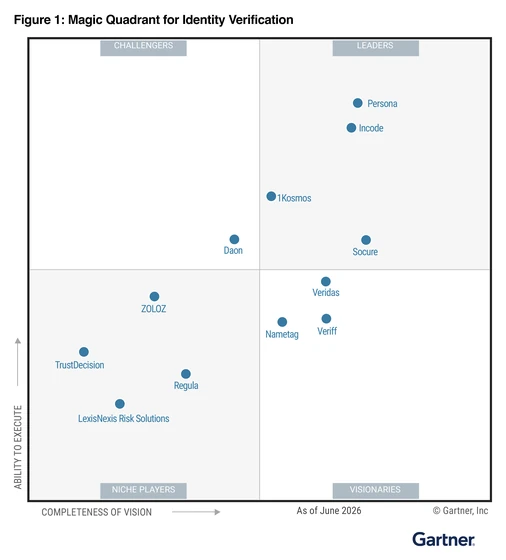
Incode was named a Leader in the 2025 Gartner® Magic Quadrant™ for Identity Verification. Download the report.