


Public sector
Protect trust in digital government
Biometric identity verification that safeguards sensitive data, public funds, and every citizen’s access to services.
We secure identities across the public sector worldwide
AI identity verification and KYC compliance, proven where fraud pressure is highest.
What the industry is up against
Public services face a new era of fraud
85% of identity fraud in 2024 involved deepfakes or generative AI tools (DHS), and North America saw a 1,740% rise in deepfake attacks between 2022 and 2023 (Security.org).
State-scale AI fraud
Cybercriminals, often state-backed, deploy deepfakes, injection attacks, and synthetic identities legacy systems cannot detect.
Stolen and misused PII
With legitimate PII abundant on the dark web, fraudsters impersonate real citizens to reach benefits and public funds.
Security versus accessibility
Stronger verification protects public trust, but outdated approaches slow service delivery and frustrate citizens.
Multi-angle attacks
Organized fraud combines stolen data, fake documents, and altered biometrics to beat single-point defenses. Manual review cannot keep up.
Incode solutions
High-assurance identity for government services
Coverage across the full identity lifecycle, from the first onboarding check to every high-risk transaction that follows.
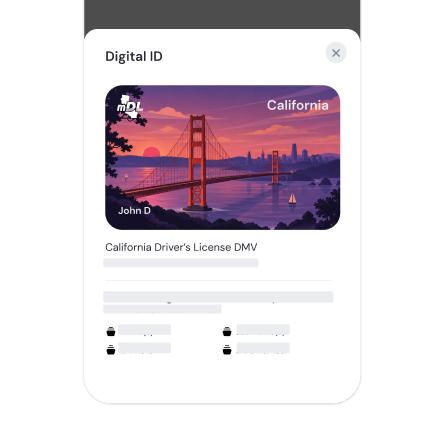
Digital ID verification
Issue and verify digital identity that surpasses NIST 800-63-3 IAL2 standards.
Learn moreIdentity verification
Onboard, verify, and authenticate citizens in seconds, end to end.
Learn moreNon-document verification
Deterministic verification against authoritative government systems of record.
Learn moreDeepfake detection
Deepsight blocks deepfakes and injection attacks with real-time biometric and device signals.
Learn more99%
fraud reduction
40%
higher conversion rates
11x
faster onboarding
User experience
How it works
One identity for every interaction, verified in real time.
Why public-sector agencies choose Incode
Independent layers of defense for every identity
Fraud that adapts will eventually fool any single check. Incode verifies every identity across independent layers, each reading a different signal, in milliseconds. Good customers pass without friction while fraud has to beat every layer at once.
Document verification
AI-powered detection of paper forgeries, screen spoofs, and digitally generated IDs.
See it in actionBiometric liveness
Liveness detection confirms a live person is present and matches the face to the document in milliseconds.
See it in actionAI-generated document detection
Deepsight for Documents catches forged, tampered, and fully synthetic IDs, fraud that template checks and barcode validation were never built to see. 8.8x more fraud caught than document checks alone.
See it in actionGovernment-record biometric matching
GovFaceMatch verifies a live selfie against DMV records instead of documents, so there's nothing to forge. 6x faster, 20% higher conversion, 150x lower false acceptance vs document-based verification.
See it in actionAgentic fraud detection
Agentic Identity securely identifies and continuously monitors autonomous AI systems to prevent fraud, ensure compliance, and build trust.
See it in actionPrivacy is the architecture
We made privacy a founding conviction long before regulation or the market asked for it. Incode's AI-first identity verification reduces fraud while remaining private and compliant.
Read the ManifestoCase study
A leading LATAM nation ran electronic voting on Incode Omni, bringing high-assurance identity verification to one of democracy’s most sensitive processes.
Electronic voting · LATAM
Read the story

FAQ
Common questions about identity verification for the public sector
Still have questions? Talk to an expertWhy do public-sector agencies need identity verification?
85% of identity fraud in 2024 involved deepfakes or generative AI tools (DHS), and North America saw a 1,740% rise in deepfake attacks between 2022 and 2023 (Security.org). Biometric identity verification safeguards sensitive data, public funds, and every citizen’s access to services.
What is agentic fraud, and why does it matter for public-sector agencies?
Agentic fraud is identity fraud run by an autonomous AI agent that generates deepfakes and synthetic documents, submits them, learns from each rejection, and retries at scale. It matters for public-sector agencies because your fraud controls assume attacks are limited by human effort, and this one isn't: it probes until it finds your weakest point, at the cost of compute. Stopping it takes layered defense across both the media and the capture path. Learn more about agentic fraud here.
How does AI identity verification speed up onboarding?
AI identity verification reduces onboarding from days to seconds: it verifies documents and biometrics in a single automated flow, with no manual review queues. That directly improves conversion rates and reduces abandonment at account opening.
How does Incode help with digital ID verification?
Issue and verify digital identity that surpasses NIST 800-63-3 IAL2 standards. Onboard, verify, and authenticate citizens in seconds, end to end.
Resources
Resources on the public sector

Why deepfake detection benchmarks fall apart on production data
Why do public deepfake detectors fail on production data? Incode's Efim Boieru shares what a high benchmark score hides and how to test detectors before trusting them.
Read more
Verify US mobile driver's licenses from every wallet with Incode Digital ID Verification
Incode Digital ID Verification is here. Verify mobile driver's licenses from every major US wallet through one integration, with cryptographic proof in 4 seconds.
Read more
FinCEN confirms mobile driver's licenses are valid ID for KYC
See what FinCEN's September 2026 mobile driver's license guidance requires for bank KYC and how to verify digital IDs without adding friction.
Read more