
Why network fraud detection matters in the age of agentic AI
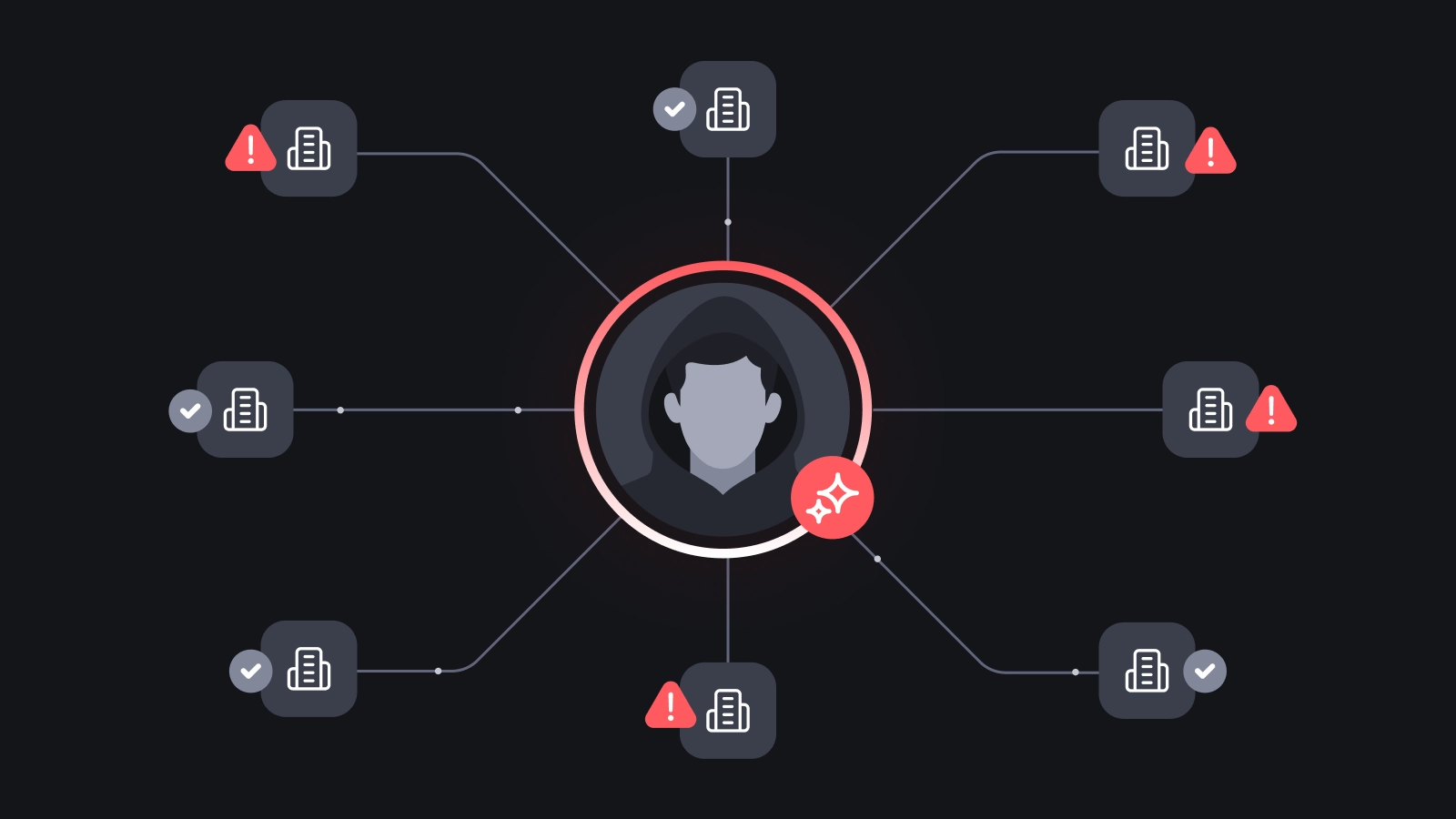
Fraudsters rarely stop at one target. A single person or group applies for accounts at dozens of banks, lenders, and fintechs. At every step in that chain, individual institutions face the same challenge: they can only access applications within their own system. So, to each company, a known fraudster looks brand new, and a pattern that could be obvious across the industry remains invisible.
That blind spot grows more costly as AI agents take over more of the work.
TrustGraph, Incode’s answer to fraud silos, is the first biometric-anchored, privacy-preserving trust network built for the agentic era. It helps institutions detect repeat fraud and recognize legitimate customers in real time by matching de-identified signals from verification events across participating institutions, so raw customer data stays in each institution's own environment.
In this post, I'll explain why attacks driven by agentic AI are making network intelligence more vital than ever and how privacy-preserving fraud intelligence works in practice.
Why agentic AI attacks spread across institutions
Fraud once scaled with people, then with software, and now AI agents run much of the work on their own. Agentic AI does two things at once. It manufactures the weapons, such as deepfakes and synthetic identities (fraudulent identities built from a mix of real and invented details). It also coordinates the attacks, probing defenses, learning from each rejection, and trying again.
The Federal Reserve warns that criminals are using generative AI to make synthetic identity fraud faster, larger in scale, and more effective. Incode’s data shows how quickly the shift is happening: AI-driven fraud accounted for 3% of fraud attempts in 2024 and 40% in the first quarter of 2026. Incode projects that figure will reach 61% by the end of 2026.
An agent can run the same playbook against many institutions in parallel, around the clock. An attack that once took a fraud crew a week can now take an agent an afternoon. The attackers operate as a network, while each defender still sees one institution at a time.
But that scale leaves a fingerprint. Between institutions, a pattern emerges, one that may look unique at first but quickly becomes identifiable, with the right information, that is.
The evidence exists. The question is who can see it.
What network fraud detection reveals that a single company can't see
Network fraud detection compares fraud signals across institutions, so a pattern that looks like an isolated event inside one company shows up as repetition across several.
Research from Liminal provides a sense of the scale of networked fraud. One fraud actor targeted as many as 30 different businesses, and each business treated that actor as a first-time applicant. In the same report, one fraud entity turned up behind 949 different identity documents. A single institution sees only the few attempts that happen to reach it.
To give a sense of what network intelligence provides, let’s go through three common scenarios:
- A stolen identity is caught at one bank. Six days later, the same face appears in an application at another bank with a different document. The second bank has no record of the first attempt, so the application looks new.
- One document number appears at three institutions within weeks, each time with a different face attached. No institution sees more than its own single attempt.
- One device opens applications at six institutions in a single afternoon, and each application looks fine inside the institution that receives it.
In each case, additional context that could help understand the attempt already exists at another institution.
Why fraud data sharing stalls on privacy
Institutions have good reason to desire coordinated intelligence, and regulators increasingly encourage it, too. In June 2026, FinCEN updated its guidance to confirm that the Section 314(b) safe harbor, a voluntary program for registered financial institutions in the United States, covers sharing information about suspected fraud, and that said sharing can happen in real time.
However, even with a safe harbor, moving customer information between institutions adds work and risk. Each new arrangement creates another privacy and audit surface to defend, and each institution has to trust how its peers handle the data they receive. Consortium models typically respond by pooling records in a central place, which concentrates that data in one location.
Compliance and security teams are left with a practical question: how can an institution see patterns across other institutions while its raw customer data stays in its own environment?
TrustGraph uses patented peer-to-peer cryptographic technology to connect signals without pooling, exchanging, or exposing customer records.
How privacy-preserving fraud intelligence works
TrustGraph protects privacy in three ways: customer data stays inside each institution, institutions compare only de-identified signals, and no central database holds a copy of anything.
Customer data stays inside each institution. Each institution keeps its raw customer data in its own environment. When Incode verifies a person, its privacy-preserving cryptographic technology turns that event into a de-identified signal, a coded stand-in for the person's details that reveals none of them. No name, document number, biometric, or raw identifier leaves the institution where it originated.
Institutions compare signals without seeing each other's data. TrustGraph matches signals across institutions using secure multi-party computation (SMPC). SMPC lets several parties find out whether their inputs match without any party seeing another's data.
No central database exists to breach. No central data lake or data broker sits in the middle, so attackers have no single store of customer records to target.
A TrustGraph query runs in four steps:
- Verify the identity. The customer completes the Incode identity journey the institution already runs. Every signal is anchored to the verified person behind that journey, because devices rotate and identity details can be bought while the person stays the same.
- Query TrustGraph privately. Identifiers are de-identified within the institution's environment before TrustGraph queries the network for relevant signals.
- Receive an explainable signal. TrustGraph returns a category-level result with supporting context, where applicable. Customer records are never returned or exposed.
- The institution decides. The institution incorporates the signal into its existing decisioning. TrustGraph provides the intelligence; the institution stays in control.
Four privacy protections are built into every query:
- End-user de-identification. Customer identifiers are de-identified before they leave the institution's environment, so raw customer data never crosses the network.
- Requestor de-identification. No participant can tell which institution submitted the query.
- Voucher de-identification. The requesting institution cannot see which participants contributed to the result.
- No response disclosure. No contributing institution learns anything from the outcome of a query.
These guarantees are built into the architecture, which lets institutions that compete share intelligence without sharing customer data.
What a trust network changes for fraud and risk teams
TrustGraph adds network intelligence to the identity decisions institutions already make, and different teams feel the benefit in different ways:
- Fraud and risk leaders catch the fraud their models already cleared. TrustGraph surfaces attacks an institution could not see because the evidence sat at another institution, so repeat attacks stop before they scale.
- Product and onboarding leaders approve more legitimate customers without increasing fraud exposure. Explainable network trust signals feed into existing decisioning, so friction concentrates on the customers who need it.
- Fraud operations teams investigate a fraud ring as one case instead of ten separate reviews.
- Security and compliance teams see repeat fraud without exposing customer data, and they can explain the architecture to regulators and examiners in plain terms.
In Incode's Early Access Program, TrustGraph detected up to 53% more fraud than existing models alone at the best-performing institution.
Fraud is already networked. Now your defense is too.
Ready to see how TrustGraph adds network intelligence to the identity checks you already run? Request a demo today.