Deepfake and digital attacks
Counterfeit visual data that deceives camera-based verification systems.
 Highlights
 Introducing TrustGraph
The first trust network built for the agentic era
Read more
Introducing TrustGraph
The first trust network built for the agentic era
Read more
 Age Center
Understand Incode’s approach to age assurance
Explore the Center
Age Center
Understand Incode’s approach to age assurance
Explore the Center
 Introducing GovFaceMatch
The first identity solution to match biometrics against DMV records
Read more
Introducing GovFaceMatch
The first identity solution to match biometrics against DMV records
Read more
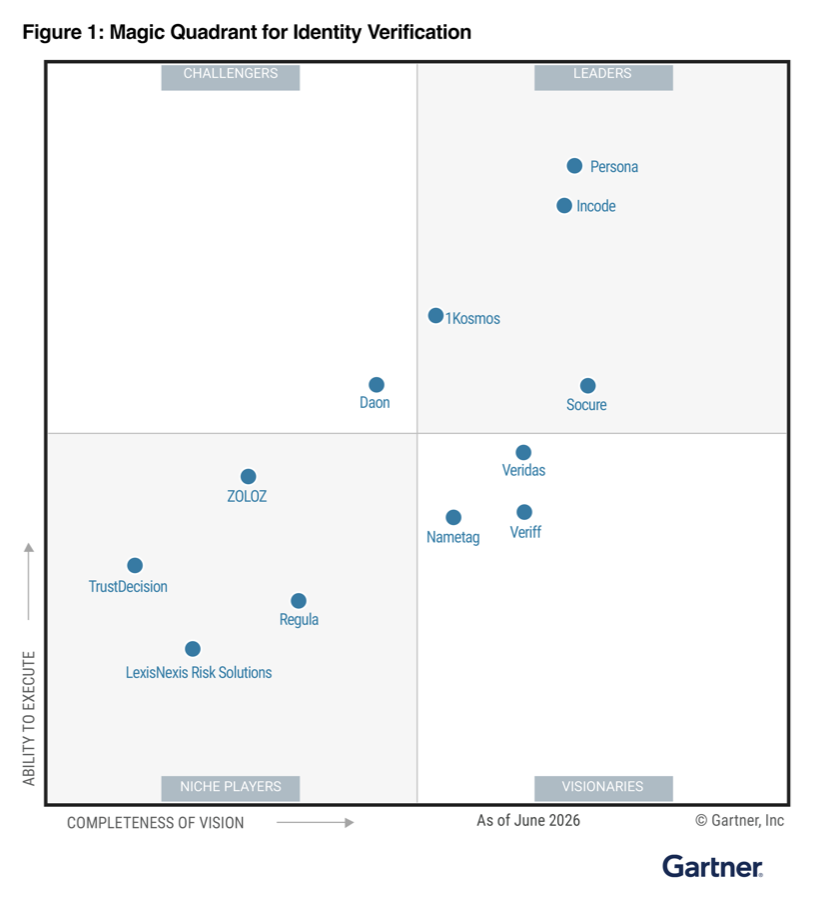
 3 years in a row named a Leader
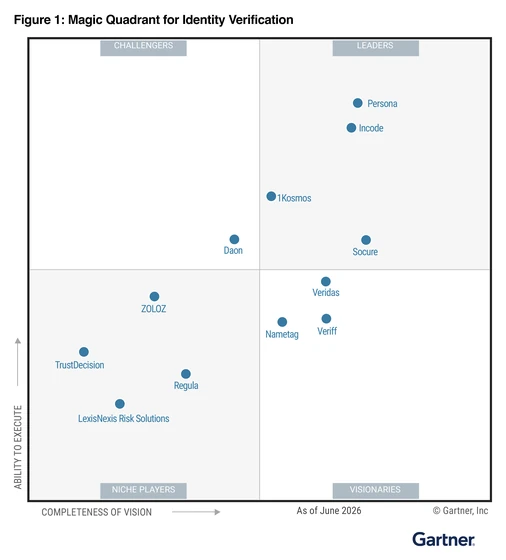
A Leader in the 2026 Gartner® Magic Quadrant™ for Identity Verification
Download the report
3 years in a row named a Leader
A Leader in the 2026 Gartner® Magic Quadrant™ for Identity Verification
Download the report
Facing fraudsters
They could be manipulating your systems to appear as someone else, or they might not be a live person at all.
Counterfeit visual data that deceives camera-based verification systems.
Visual data manipulated with high-quality screens or printed images to trick camera-based verification systems.
Individuals alter their appearance to make it harder for facial recognition systems to verify their biometric features.
Surge in deepfake fraud attempts over the last 3 years
Of businesses claim identity fraud losses have increased in recent years*
Common attacks
How it works
Within Incode's liveness, we employ multi-modal intelligence to maximize accuracy of liveness detection without slowing down the end-user experience.
Technical benefits
Discover how Incode Deepsight’s advanced liveness technology tackles fraud without impacting your user experience.
Unlike other providers who rely on third-party vendors, we build and own our entire technology stack. Our AI/ML models, powered by deep learning and designed for identity verification, allow us to train on the latest document and biometric fraud vectors. This full control enables us to tailor our models to the unique needs of our clients, ensuring superior performance and flexibility.
Using advanced neural networks, including both standard Convolutional Neural Networks (CNNs) and cutting-edge Large Vision Models (LVM) and transformers, we train our models to achieve state-of-the-art results across various tasks. Over nearly a decade, we’ve curated large, statistically representative datasets, so our models deliver balanced performance across variables like age, skin tone, and gender. Our in-house Fraud Lab has compiled over 1 million unique presentation attacks, from basic printouts to advanced 3D masks. We also generate synthetic data such as face swaps and synthetic faces, enhancing the robustness of our models.
Our internal testing environment is designed to be more challenging than real-world spoof attempts. By testing our models against complex attacks, we ensure perfect detection rates in production. This way, we can prevent known fraud networks, repeat verification attempts, and other fraudulent behaviors before they impact your business.
Incode advanced liveness incorporates detection across various modalities, such as depth and motion, and multiple frames, multiplying its accuracy.
Our liveness detection AI models are continuously refined by Incode’s Fraud Lab, where our team trains our proprietary AI technology in response to the latest emerging fraud techniques. Unlike competitors who rely on third party providers, we can immediately train our in-house models to analyze input for emerging fraud types, ensuring these attacks are neutralized before they impact your business.
Verified proof







0%
false positives and false negatives in independent testing by the Georgia Department of Driver’s Services (iBeta Level 2 protocols, 2024).
0
false positives and false negatives · Georgia DDS, iBeta Level 2 protocols, 2024
0%
false positive and false negative rate · Michigan State MSU-MFSD evaluation, 2023
1M+
unique presentation attacks compiled by Incode's in-house Fraud Lab
Incode's liveness detection prevents face swapping, face morphing, 2D synthetic assets, face reenactment, and video replays through advanced digital spoof detection algorithms.
Incode detects 2D masks, 3D masks, paper printouts, cardboards, and video replays through ML models designed to identify physical spoofing attempts.
Incode's algorithms check for evasion attempts including exaggerated expressions, occluding objects like hats and glasses, and heavy makeup that aims to confuse recognition systems.
Incode achieved 0% false positives (false acceptance of fraudulent users) and 0% false negatives (false rejections of genuine users) in independent testing by the Georgia Department of Driver's Services according to iBeta level 2 protocols in 2024.
What's next